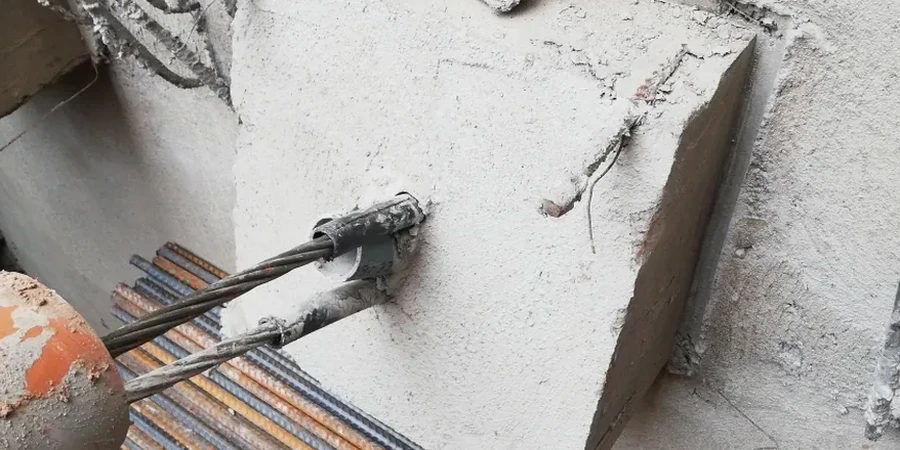
In Barnsley, the ground rarely gives you an easy start. You strip the topsoil and hit stiff glacial till, or worse, weathered sandstone from the Pennine Middle Coal Measures with bands of mudstone that degrade fast once exposed. We have seen excavation faces stand for days and then unravel after a single heavy rain. That is exactly why anchor design here cannot be a copy-paste exercise from a manual. We specify active anchors when movement must be controlled from day one—think basement dig next to a Victorian terrace—and passive anchors where the ground can be allowed to strain a little before engaging, such as behind a reinforced slope in the Dearne Valley. Every design is built around the real stratigraphy we pull from boreholes, not assumed parameters from a database. A site near Dodworth last winter had 4 metres of colluvium over sandstone; the anchor bond lengths had to be staggered to stay out of the weathered zone. Before finalising any design, we usually run CPT testing to profile soft inclusions that could compromise grout-to-ground bond, and when the site geometry allows, we complement that with test pits to physically inspect the near-surface layers where passive blocks will bear.
An anchor is only as good as the ground it bonds to—and in Barnsley that means designing for fractured rock, perched water, and legacy mine workings, not textbook conditions.
Our approach and scope
Our designs follow BS 8081:1989 and the relevant sections of Eurocode 7 (BS EN 1997-1:2004), but we go further than the code minimums. For every anchor we compute the apparent coefficient of friction at the grout-ground interface based on site-specific pressuremeter data or SPT correlations, never from generic tables. Active anchors are typically proof-tested to 1.5 times the working load and locked off at a defined percentage, usually 70 to 80 percent, to allow for relaxation while still controlling movement. Passive anchors, by contrast, are only stressed during the suitability test to confirm the ultimate bond capacity. In Barnsley, where the bedrock can vary from competent sandstone to fractured mudstone within a single anchor length, we often specify a sacrificial anchor programme on larger sites—three or four anchors tested to failure so we can calibrate the bond stress before production drilling begins. The grout mix is designed for the local groundwater conditions, always with a water-cement ratio not exceeding 0.45, and we require continuous grout pressure monitoring during installation. The anchor head detailing matters too: in the exposed moorland sites north of the town centre, we recess the head and apply a flexible seal over the bearing plate to handle thermal movement that would crack a rigid cover.
Quick answers
What is the difference between active and passive anchors?
Active anchors are tensioned during installation and lock off a predefined load, so they control movement immediately. Passive anchors are not stressed; they only develop resistance when the ground starts to move and stretches the tendon. In Barnsley we typically use active anchors for retaining walls next to existing structures where even 10 millimetres of movement could cause cracking, and passive anchors for slope stabilisation where some initial deformation is acceptable before the system engages.
How do you account for old mine workings in the anchor design?
We start with a coal mining risk assessment and review abandonment plans from the Coal Authority. If workings are suspected within the anchor bond zone, we extend the investigation with rotary cored boreholes to confirm void locations. The bond length is then designed to sit entirely in competent rock below the worked seam, or we specify a reduced bond stress and longer fixed anchor length if avoidance is not possible. In some cases we fill shallow workings with low-pressure grout before anchor installation.
What does active and passive anchor design cost in Barnsley?
Design fees for a typical project in Barnsley range from £760 to £3,270, depending on the number of anchors, the complexity of the ground conditions, and the testing requirements. A small retaining wall with four active anchors might fall at the lower end, while a large slope stabilisation with twenty passive anchors and a sacrificial testing programme would be at the upper end. All fees cover the design report, construction drawings, and testing specifications.
How long does a suitability test take on site?
A single anchor suitability test typically takes 2 to 3 hours, including the incremental loading and unloading cycles specified in BS EN 1537. We require the grout to reach at least 80 percent of its 28-day strength before testing, which in Barnsley's cool climate usually means 5 to 7 days of curing for ordinary Portland cement grout, or 3 to 4 days if we use an accelerated mix. Multiple anchors can be tested in sequence over a single day.