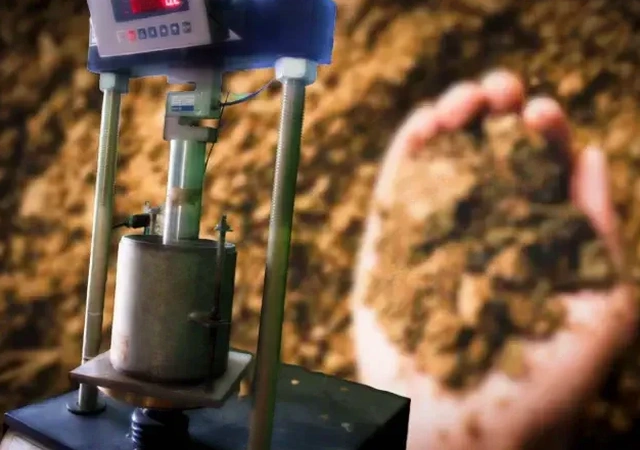
A multi-speed loading press applies a 2.5 mm/min penetration rate onto a compacted specimen inside a CBR mould. In Barnsley, we run this test on samples taken straight from local cuttings and embankments. The machine records force versus penetration up to 10 mm, comparing readings against a standard crushed stone reference. Most Barnsley sites involve glacial till or weathered Coal Measures mudstone, materials that need careful moisture conditioning before compaction. After compaction, specimens soak for 96 hours under a surcharge weight to simulate field conditions beneath a pavement. The soaked CBR value tells the real story. Unsoaked tests provide the upper bound, useful during construction control when weather windows are tight. We complement the laboratory programme with in-situ permeability checks on site to confirm drainage assumptions, and proctor tests to establish the compaction reference density for each material type encountered across the borough.
CBR is a comparative index, not a fundamental soil property. A 5% soaked CBR on a Barnsley grey shale means something very different from a 5% CBR on a clean sand.
Our approach and scope
Barnsley's ground shifts from sandstone cappings on the west to soft shale and alluvium in the Dearne Valley. That contrast demands different compaction energies and moisture targets. Our lab adjusts the Proctor compactive effort based on the material classification before running the CBR sequence. We test at optimum moisture content and at ±2% either side, giving a sensitivity curve that the pavement designer can use directly. For capping layers under flexible roads, we follow Series 600 of the Specification for Highway Works. The test runs on both fine-grained and granular soils, though granular materials need careful trimming of the surface before the plunger seats. Data is logged at 0.25 mm intervals, and the force-penetration curve is corrected for initial seating errors where needed. Soaking is done with a dial gauge recording swell, because in Barnsley the clay fraction can expand and chew up a pavement from underneath.
Quick answers
What does a laboratory CBR test cost for a Barnsley project?
A single-point CBR test, including compaction and 4-day soak, ranges from £110 to £180 depending on the number of specimens and surcharge setup required. We offer discounted rates for batch testing of five or more samples from the same site.
How long does the CBR test take from sample delivery to report?
A soaked CBR test requires four full days for the soaking phase. We begin compaction on day one, soak days two through five, and run penetration on day five. Reports are issued the same day. Unsoaked tests can be reported within 24 hours of sample receipt.
What sample mass do you need for a CBR test?
We need approximately 25 kg of material per CBR point. The material should be bagged and sealed on site at its natural moisture content. For fine-grained soils, a single undisturbed core can also be used if the mould can be trimmed directly from the sample.
Is the laboratory CBR the same as a field CBR test?
Not exactly. The laboratory CBR uses a standard compactive effort and controlled soaking, giving a repeatable index for pavement design. Field CBR tests measure in-situ strength at natural moisture and density. We recommend laboratory CBR for design and field CBR for compaction verification during construction.