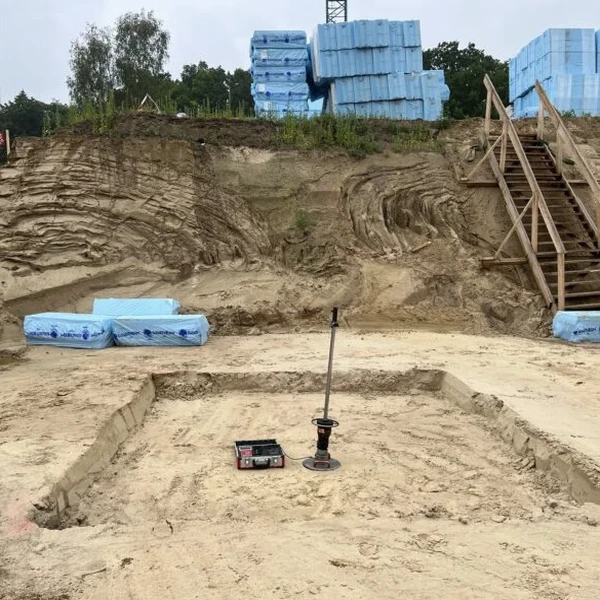
A recent motorway widening scheme near Junction 37 of the M1 exposed typical Barnsley ground conditions — weathered sandstone overlying shale with pockets of glacial till. The contractor's spec called for 95% relative compaction on the embankment fill but initial nuclear density readings failed. The problem wasn't the compaction effort. The lab reference density was wrong. We ran a Modified Proctor on the on-site borrow material, established the correct maximum dry density at 2.18 Mg/m³, and the next lift passed. In Barnsley's mixed geology, particularly across the exposed Upper Carboniferous strata that dominate the Dearne Valley, the Proctor test isn't a formality. It's the single parameter that determines whether an earthworks job gets signed off or ripped out. Complementing this with a sand cone density test provides the field verification loop, while evaluating CBR for road subbase links compaction directly to pavement design strength.
Compaction isn't about hitting a number on the gauge. It's about the relationship between moisture content and density — and getting that relationship right in the lab first.
Quick answers
What's the difference between Standard and Modified Proctor?
The Modified Proctor uses a 4.5 kg rammer dropping 450 mm and delivers about 4.5 times more compactive effort than the Standard Proctor (2.5 kg rammer, 300 mm drop). Modified is specified for heavily loaded pavements, airfields, and motorway embankments. Standard Proctor suits landscape fill, trench reinstatement, and low-rise building platforms. In Barnsley's redevelopment sites on former colliery land, the spec usually calls for Modified because the made ground is unpredictable.
How much does a Proctor test cost in Barnsley?
A Standard or Modified Proctor test typically ranges from £70 to £150 depending on whether you need the full 5-point curve or a reduced scope. Material preparation — drying, sieving, and particle density determination — is included. Rush turnaround within 48 hours may carry a surcharge. Call the lab for a project-specific quote.
How long does a Proctor test take?
From sample receipt to issued report, allow 3 to 5 working days for a full moisture-density relationship. The oven drying step alone takes a minimum of 16 hours per moisture point. If you need same-week results for an active earthworks operation, let us know in advance and we'll schedule it into the lab queue accordingly.