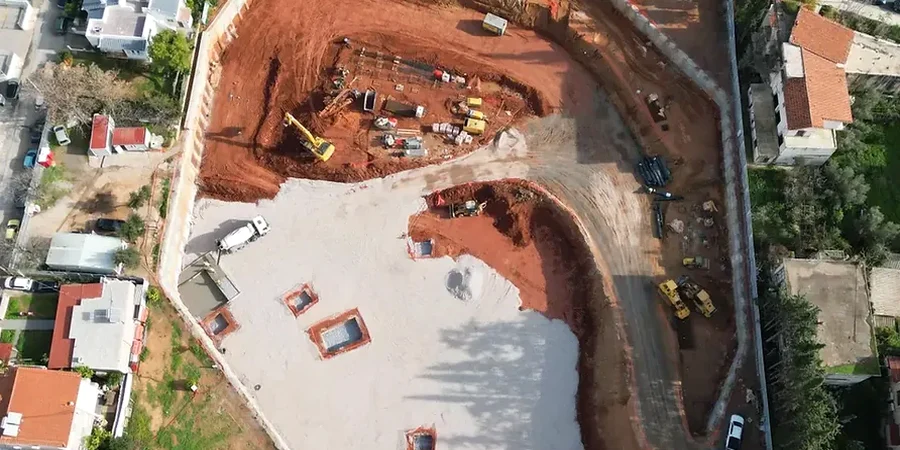
BS EN 1997-1:2004 (Eurocode 7) and BS 5930:2015 set the framework for every deep excavation we design in Barnsley. The town sits on Carboniferous Coal Measures—interbedded sandstones, siltstones, and mudstones—overlain by glacial till and pockets of made ground. In the town centre, where redevelopment pushes basements deeper, the weathered mudstone can soften rapidly on exposure, affecting stand-up time. Our laboratory testing programme for these projects typically starts with multistage triaxial tests to define the effective stress parameters of the sandstone bands and index testing of the mudstone to quantify slake durability. Understanding the groundwater regime is critical here because perched water in the till and fracture flow in the bedrock can lead to base instability if not properly drained or depressurised. For adjacent buildings on shallow footings, we often recommend excavation monitoring with inclinometers and vibration sensors to validate movement predictions and protect third-party assets during construction.
In Barnsley’s Coal Measures, the difference between a successful basement and a collapse often comes down to how well you’ve characterised the weathered mudstone’s slake durability before specifying the shoring.
Our approach and scope
Barnsley’s development since the 19th century has left a complex subsurface legacy. The town grew around the coal and glass industries, and much of the central area is underlain by backfilled former colliery shafts, bell pits, and unrecorded mine entries. Historical maps from the Coal Authority show dense workings beneath areas like Honeywell and Kendray. Our approach to deep excavation design here begins with a desk study that overlays geological mapping (BGS Sheet 87) with mining records to identify zones of potential void migration. In the laboratory, we run particle size distribution tests on the glacial till to characterise its drained strength, which governs the earth pressure diagram for the shoring system. Where the excavation cuts through the till into the weathered mudstone, the design often transitions from a stiff cantilever wall to a propped or anchored system. In our experience, the biggest variable is the condition of the mudstone: fresh rock can stand near-vertical for days, but the weathered zone needs immediate support and a solid specification for sprayed concrete lining.
Quick answers
How much does a geotechnical design of deep excavations cost in Barnsley?
For a deep excavation project in Barnsley, the geotechnical design package typically ranges from £1,630 to £6,840 depending on the depth, complexity of the ground conditions, and the extent of laboratory testing required. A simple cantilever wall design for a 4 m basement starts at the lower end, while a fully instrumented propped excavation over 10 m deep with multiple Coal Measures strata falls at the higher end.
How do you deal with old mine workings beneath an excavation in Barnsley?
We start with a Coal Authority mining report and a review of historical abandonment plans. If workings are within a depth of influence, we specify rotary drilling with water flush to detect voids and core the rock mass. Where voids are found, the design includes a grouting programme to fill them and a revision of the shoring loads to account for the changed ground conditions.
What monitoring is required during excavation near existing buildings in Barnsley town centre?
We specify a monitoring plan that includes settlement markers on adjacent footpaths and buildings, inclinometer casings in the shoring wall, piezometers to track groundwater drawdown, and vibration monitors if breaking rock with hydraulic breakers. Readings are taken daily during active excavation and compared against pre-defined trigger levels to keep movements within the agreed limits.