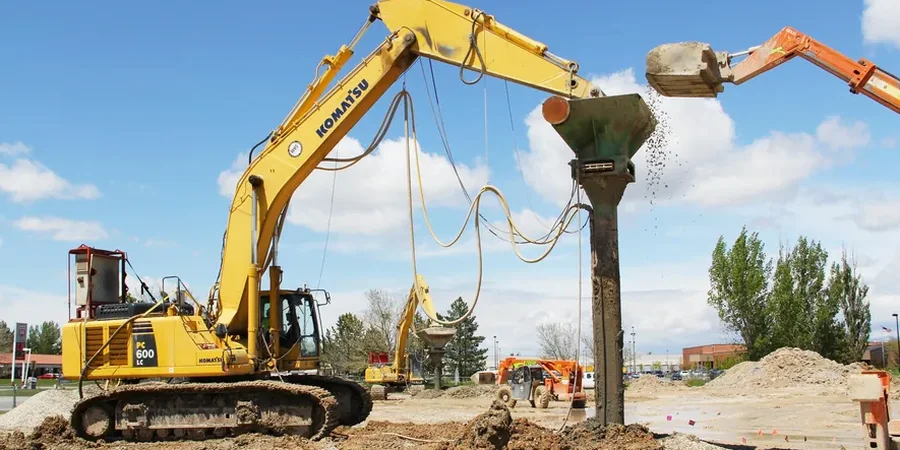
Ground conditions vary sharply across Barnsley. The sandstone bedrock that surfaces around the town centre gives way to alluvial deposits and colliery spoil in areas like Stairfoot and Worsbrough. A foundation solution that works on the hilltops can fail completely in the Dearne Valley floodplain. Vibrocompaction design bridges this gap. It densifies loose granular fills and natural sands to create a uniform bearing stratum. The approach relies on depth-controlled vibrating probes that rearrange soil particles into a denser matrix. For Barnsley’s legacy of mining backfill and former industrial yards, the method often eliminates the need for deep piles. We combine site-specific penetration data with CPT testing to map target zones, then design compaction grids that meet the serviceability limits in BS EN 1997-1. The result is predictable settlement behaviour on ground that would otherwise require over-excavation.
A well-designed vibrocompaction grid turns loose backfill into a dense bearing layer that meets Eurocode 7 serviceability limits without over-excavation.
Quick answers
What does vibrocompaction design cost for a typical Barnsley industrial plot?
Design fees for a single-building plot of around 500 m² to 2,000 m² in Barnsley fall between £1,080 and £4,660. The range depends on whether a trial grid is required, the number of verification CPTs, and the complexity of the ground model. A fixed-price proposal follows a site walkover and review of available ground investigation data.
Which Barnsley ground conditions rule out vibrocompaction?
Vibrocompaction works on granular soils with fines content typically below 15%. It is ruled out in thick cohesive deposits, peat, or ground with undocumented mine entries within the treatment depth. Sites near the Dearne where soft alluvial clays dominate usually require a different ground improvement strategy, such as stone columns or rigid inclusions.
How do you verify the design after the compaction work is finished?
Verification follows BS EN 1997-2. We compare pre- and post-treatment CPT soundings on the same grid points. If relative density falls short, we tighten the probe spacing and re-treat. Zone load tests provide direct settlement data for critical structures. The final report confirms the as-built ground properties against the design assumptions.