← Home · Ground improvement

Stone Column Design for Soft Ground in Barnsley

Together, we solve the challenges of tomorrow.

LEARN MORE →

The Dearne Valley cuts right through Barnsley. Centuries of mining and river deposits left a legacy of soft, compressible ground that standard footings just cannot handle. We see it every time a new development pushes into the low-lying areas near the River Dearne. The solution often sits beneath the surface: a grid of densely compacted stone columns. Our lab supports these designs with real soil data. We run the consolidation and shear strength tests that feed directly into the column spacing calculations. Without that, it is guesswork. And guesswork in Barnsley's alluvium gets expensive fast. For sites where the coal measures are shallow but the drift cover is weak, we often pair the column design with a slope stability analysis to ensure the whole platform works together.

Column spacing in Barnsley's alluvium is not a catalogue value. It comes from measured undrained shear strength and a defined settlement target.

Our approach and scope

Barnsley sits at roughly 120 metres above sea level. But elevation alone tells you nothing about what lies underneath. The local geology shifts from Pennine Middle Coal Measures to thick bands of alluvial clay within half a mile. That is why our approach to stone column design here is never a copy-paste job. We start with the BS EN 1997-1 ground model. Then we define the column diameter, typically 0.6 to 0.8 metres, and the area replacement ratio based on the target settlement reduction. The vibro-replacement process itself is straightforward. The engineering judgment lies in knowing when to stiffen the grid near old culverts or unmapped mine entries. Our technicians log every borehole metre personally. We do our own particle size distribution and triaxial testing in-house, so the friction angle of the stone fill and the undrained shear strength of the surrounding clay are measured, not assumed. This internal loop cuts turnaround time drastically.
Stone Column Design for Soft Ground in Barnsley
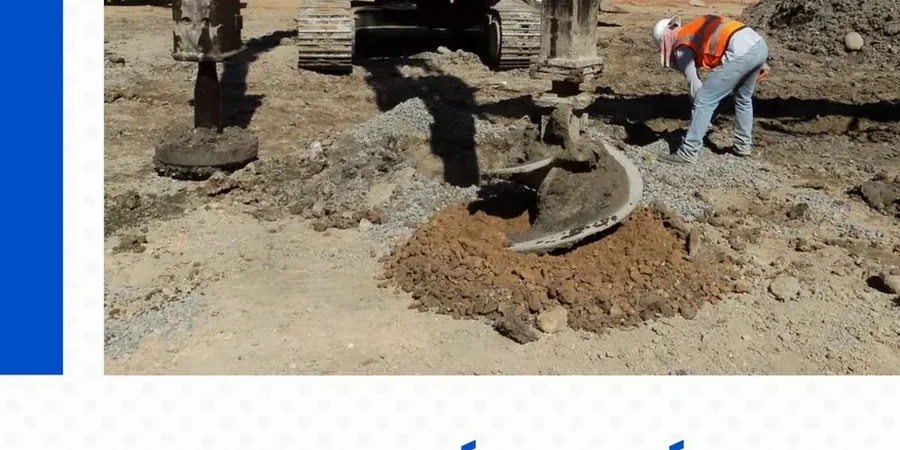
Technical reference image — Barnsley

Local ground factors

The contrast between Worsbrough and the town centre is stark. Worsbrough sits on firmer sandstone and shale near the surface. The town centre, closer to the old river terraces, is underlain by soft silts and clays that reach depths of six metres or more. We have seen projects where ignoring this difference led to differential settlement that cracked a floor slab before the building was even handed over. The risk with stone columns in Barnsley is not the column itself. It is the untreated transition zone between improved and unimproved ground. We always recommend extending the treatment beyond the footprint by at least two column spacings. Run a finite element settlement analysis. Check the lateral deformation. It is the only way to avoid a nasty surprise when the first heavy rain saturates the platform.

Need a geotechnical assessment?

Reply within 24h.

Email: contact@geotechnical-engineering.biz

Technical data

ParameterTypical value
Typical column diameter0.6 – 0.8 m
Area replacement ratio range10 – 35%
Stone fill friction angle (tested)38° – 44°
Target settlement reduction50 – 80%
Design standardBS EN 1997-1
Execution standardBS EN 14731
Common installation depth4 – 12 m
Load transfer platformGranular, 0.3 – 0.6 m thick

Other technical services

01

Preliminary feasibility assessment

Desk study and ground investigation design to confirm if stone columns are suitable for your Barnsley site. We review historical mine workings and alluvial thickness before a single rig arrives.

02

Detailed column design

Calculation of column spacing, length, diameter, and area replacement ratio. We use Plaxis 2D or Settle3 for settlement and stability analysis, calibrated with our own lab test results.

03

Performance verification testing

Post-installation plate load tests and zone load tests according to BS EN 14731. We verify the composite modulus of the improved ground matches the design assumptions.

Applicable standards

BS EN 1997-1:2004 + A1:2013 (Eurocode 7, Geotechnical design), BS EN 14731:2005 (Execution of special geotechnical works – Ground treatment by deep vibration), BS 5930:2015 + A1:2020 (Code of practice for ground investigations)

Quick answers

How much does stone column design cost for a site in Barnsley?

A full design package including ground investigation specification, lab testing, and settlement analysis for a typical Barnsley plot typically falls between £1,110 and £3,910. The range depends on the number of boreholes, the required lab testing programme, and whether a 3D finite element analysis is needed for complex loading.

How deep do stone columns need to go in South Yorkshire's geology?

It depends entirely on the depth of the soft layer. In the Dearne Valley alluvium near Barnsley town centre, we often see columns extending 6 to 10 metres to reach competent strata. We always recommend at least one borehole extending to twice the column length to confirm there is no deeper weak layer.

Can stone columns be installed if there are old mine workings beneath the site?

It depends on the depth and condition of the workings. If the mine workings are shallow and collapsed, we first need a grouting treatment to stabilise the voids. For deeper, stable workings, stone columns can be installed above them. A thorough desk study and rotary drilling investigation are mandatory before making that decision.

What is the biggest mistake you see in stone column design?

Using assumed soil parameters instead of site-specific lab data. In Barnsley, the alluvial clays vary significantly in plasticity and sensitivity. Guessing the undrained shear strength leads to columns that are either too widely spaced or unnecessarily dense. Both scenarios cost money. We test every soil layer that will interact with the columns.
Location and service area

We serve projects across Barnsley and surrounding areas.

View larger map