← Home · Slopes & Walls

Retaining Wall Design in Barnsley: Ground That Demands Precision

Together, we solve the challenges of tomorrow.

LEARN MORE →

The ground under Barnsley changes fast. Move from the sandstone outcrops around Dodworth to the alluvial clays along the Dearne Valley and you have two completely different retaining wall problems. One needs a gravity wall keyed into rock. The other needs cantilever reinforcement and deep drainage. We design for both. Our retaining wall designs work with the slope, not against it, because we map the geology first. Before we touch a calculation we correlate site data with the British Geological Survey mapping for the Pennine Middle Coal Measures. That local correlation is what stops walls from cracking six months after backfill. It is also why we often pair the design with a CBR test for roads when the wall supports a haul road or access ramp, ensuring the pavement won't undermine the structure from the top down.

A retaining wall in Barnsley fails three ways: sliding, overturning, or a missed mine entry under the toe. We design so none of them happen.

Our approach and scope

Barnsley grew on mining and textiles, leaving behind a legacy of made ground, backfilled shafts and unrecorded shallow workings. Every retaining wall design here starts with uncertainty about what is underground. The rapid expansion of the 19th century pushed terraced housing up steep valley sides, creating the stepped topography that now requires retaining structures on almost every infill plot. We model the wall not just for active earth pressure but for collapse settlement if a void migrates under the heel. For taller walls on the former colliery sites we integrate grouting programmes before excavation, consolidating the ground so the wall bears on a competent mass. Our designs follow BS EN 1997-1:2004 with Design Approach 1, applying partial factors to actions and material properties. We use GEO5 and Plaxis 3D to capture the interaction between the wall, the slope, and any surcharge from adjacent buildings. The output is a fully detailed set of construction drawings with reinforcement schedules and drainage specifications.
Retaining Wall Design in Barnsley: Ground That Demands Precision
Technical reference image — Barnsley

Local ground factors

BS 5930:2015 and BS EN 1997-2 set the ground investigation requirements, but in Barnsley the risk is not just about soil strength. It is about ground collapse. The Coal Authority reports for the area show high-risk zones where unrecorded shafts and shallow adits exist within 10 metres of the surface. A retaining wall over a forgotten shaft will not just tilt. It will drop. The trigger is usually water ingress from a broken drain, saturating the fill in the shaft and causing sudden compression. We address this by specifying a thorough desk study and a targeted intrusive investigation before design, using dynamic probing to locate voids. If evidence of mining is found, the wall foundation is designed with reinforced concrete bridging or the void is treated. Ignoring this step is a structural and legal liability.

Need a geotechnical assessment?

Reply within 24h.

Email: contact@geotechnical-engineering.biz

Technical data

ParameterTypical value
Design standardBS EN 1997-1:2004 (EC7)
Design approachDA1 (Combination 1 & 2)
Partial factor on permanent action (γG)1.35 (unfavourable)
Partial factor on variable action (γQ)1.50 (unfavourable)
Partial factor on tan φ' (γφ')1.25
Partial factor on effective cohesion (γc')1.25
Design life (retaining walls)60 years (per BS EN 1990)
Groundwater modellingSteady-state seepage with clogging allowance

Other technical services

01

Gravity and gabion wall design

For walls up to 3 metres on competent ground, we design mass concrete and gabion walls with external and global stability checks, including sliding, overturning and bearing capacity. Gabion walls suit steep sites because they drain freely and tolerate settlement.

02

Reinforced concrete cantilever walls

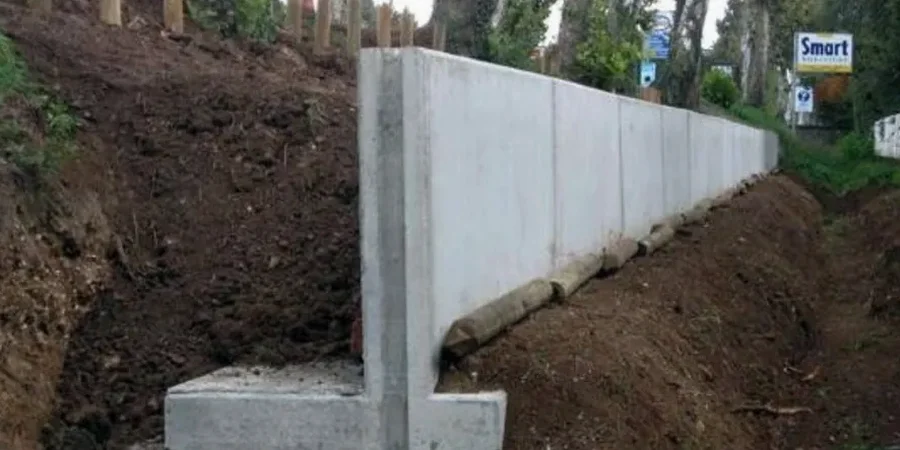
For heights above 3 metres and sites with surcharge from roads or buildings, we design RC cantilever walls with heel and toe proportions optimised for Barnsley's clay soils, complete with reinforcement detailing and construction joint schedules.

03

Embedded retaining walls and slope stabilisation

When space is tight on a hillside plot, we design sheet pile or king post walls with anchor systems. The design accounts for the downslope creep common in the weathered mudstones of the Pennine Lower Coal Measures.

Applicable standards

BS EN 1997-1:2004 (Eurocode 7: Geotechnical design), BS EN 1997-2:2007 (Ground investigation and testing), BS 5930:2015+A1:2020 (Code of practice for ground investigations), BS 8002:2015 (Code of practice for earth retaining structures), BS 8500 (Concrete specification for retaining walls)

Quick answers

How much does retaining wall design cost for a project in Barnsley?

Retaining wall design fees for a Barnsley project typically range from £870 to £3,180 depending on wall height, complexity and whether the site is in a Coal Authority high-risk area. A small gravity wall under 1.5 metres with straightforward ground conditions sits at the lower end. A reinforced cantilever wall over 3 metres, with surcharge loading, slope stability modelling and mining risk assessment, moves toward the upper end. All our quotes include the desk study, geotechnical design, structural detailing and a site-specific specification.

Do I need planning permission for a retaining wall in Barnsley?

Under the Town and Country Planning Act, a retaining wall over 1 metre high adjacent to a highway, or over 2 metres elsewhere, requires planning permission from Barnsley Metropolitan Borough Council. Walls below these heights are generally permitted development but still need building regulations approval if they affect a structure. We always recommend checking with the council's planning department before starting any design work.

What is the biggest technical challenge for retaining walls in Barnsley?

The single biggest challenge is the legacy of coal mining. Unrecorded shallow workings and backfilled shafts are common across the borough, particularly east of the M1. A wall founded over a void can fail suddenly, so we always run a Coal Authority mining report and, when necessary, specify probing or drilling to confirm ground integrity before finalising the foundation design.

What drainage do Barnsley retaining walls need?

Drainage is critical because the Pennine rainfall pattern delivers frequent, sustained wet weather. We design every wall with a continuous granular drainage blanket behind the stem, a perforated collector pipe at the base, and weep holes at 1.5 to 2 metre centres. On clay slopes we add a geomembrane cut-off at the surface to stop water running down the back of the wall and saturating the fill.
Location and service area

We serve projects across Barnsley and surrounding areas.

View larger map