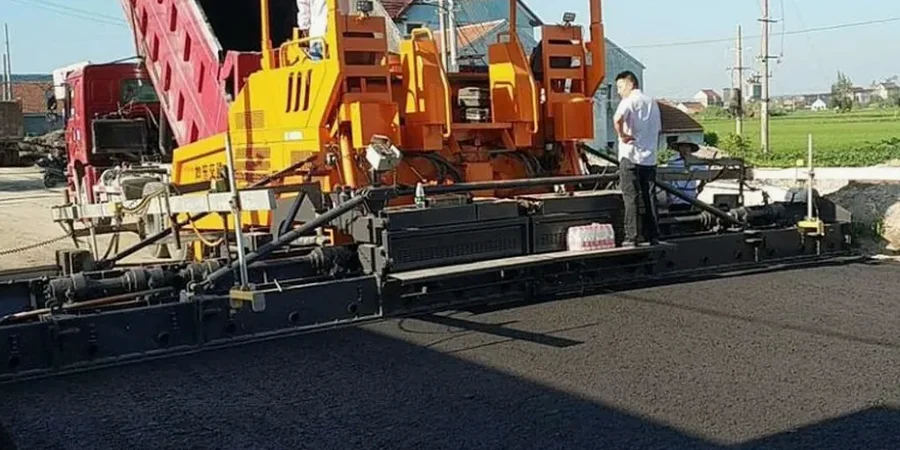
A new commercial development off junction 37 of the M1 hit a problem we see constantly around Barnsley. The ground investigation had missed a pocket of soft alluvial clay beneath the sandstone fill. The initial pavement design, based on assumed CBR values, would have failed within two winters. In our experience, Barnsley’s geology demands a flexible pavement design that starts with the soil, not the asphalt. The Dearne Valley and the slopes toward the Pennines present very different subgrade conditions, and a generic design won't cut it. We recalibrated the capping layer and specified a CBR test programme to map the variability across the site. The revised flexible pavement design saved the client from a costly reconstruction and delivered a car park that handles heavy goods vehicles without rutting. That is the difference between a desktop assumption and a design grounded in site-specific data from Barnsley’s own ground.
In Barnsley, the most expensive asphalt specification is worthless if the subgrade fails. We design pavements from the bottom up, starting with the soil's actual CBR under site moisture conditions.
Quick answers
What is a typical flexible pavement design for a Barnsley industrial estate?
For a standard industrial estate with heavy goods vehicles, we typically design for 20 to 40 million standard axles (msa) over a 40-year design life. The foundation design is critical. If the subgrade CBR is below 5%, we specify a capping layer and often stabilise the subgrade with lime. The pavement usually comprises a granular sub-base, a dense bitumen macadam (DBM) binder course, and a stone mastic asphalt (SMA) surface course for deformation resistance.
How much does a flexible pavement design cost for a project in Barnsley?
The design cost depends on the site area and the complexity of the ground conditions. For a typical commercial development in Barnsley, a full flexible pavement design, including the necessary site investigation and CBR testing, ranges from £1,270 to £3,840. This covers the interpretive report, the foundation design, and the pavement layer specification.
Do I need a site investigation before the pavement design?
Absolutely. The design is only as good as the ground model. We need dynamic cone penetrometer (DCP) tests or laboratory CBR tests on samples taken from the subgrade level. In Barnsley, where the ground can change from sandstone to soft clay over a few metres, a proper site investigation is the only way to avoid a pavement failure.
Can you design a flexible pavement that uses recycled materials?
We can. We often specify reclaimed asphalt planings (RAP) and recycled concrete aggregate (RCA) in the sub-base and binder course where the material meets the specification. This is a cost-effective and sustainable approach, and it works well in Barnsley when the source material is properly tested and processed.