← Home · Seismic

Base Isolation Seismic Design in Barnsley: Laboratory Testing & Site Characterisation

Together, we solve the challenges of tomorrow.

LEARN MORE →

Ground conditions shift noticeably between the sandstone ridges around Old Town and the alluvial clays of the Dearne Valley floor. A housing block on Huddersfield Road sits on weathered Middle Coal Measures, while a warehouse off junction 37 near Dodworth contends with soft silty deposits that amplify low-frequency motion. In Barnsley the seismic hazard is moderate, but the soil profile makes all the difference. Base isolation seismic design turns on accurate shear modulus data, damping ratios, and site-specific response spectra. We run resonant column and cyclic triaxial tests on undisturbed samples from your boreholes, feed the numbers into equivalent-linear site response models, and deliver the isolator design parameters the structural engineer actually needs. Combined with a seismic microzonation study we map how the impedance contrast varies across the site, something that standard desk-study values simply miss.

An isolator period tuned to 2.5 seconds on paper means nothing if the site-specific Gmax is 30% lower than the desk-study assumption.

Our approach and scope

Eurocode 8 Part 1 (BS EN 1998-1:2004) requires a Ground Investigation Report that goes well beyond SPT N-values when base isolation is on the table. In Barnsley the glacial till and post-glacial soft clays create a stiff-over-soft profile that can concentrate strain at the isolator level. Our laboratory follows BS EN ISO 17892 for dynamic testing: we measure small-strain shear modulus via bender elements, then run strain-controlled cyclic triaxial tests at confining pressures matching the foundation depth. The degradation curve of G/Gmax with shear strain feeds directly into the isolator bearing design. For sites near the River Dearne where groundwater is shallow, we also run in-situ permeability tests because excess pore pressure build-up during a seismic event alters the effective stress and shifts the whole dynamic response. Every test report includes the derived parameters for lead-rubber or friction-pendulum bearing specification, not just raw data.
Base Isolation Seismic Design in Barnsley: Laboratory Testing & Site Characterisation
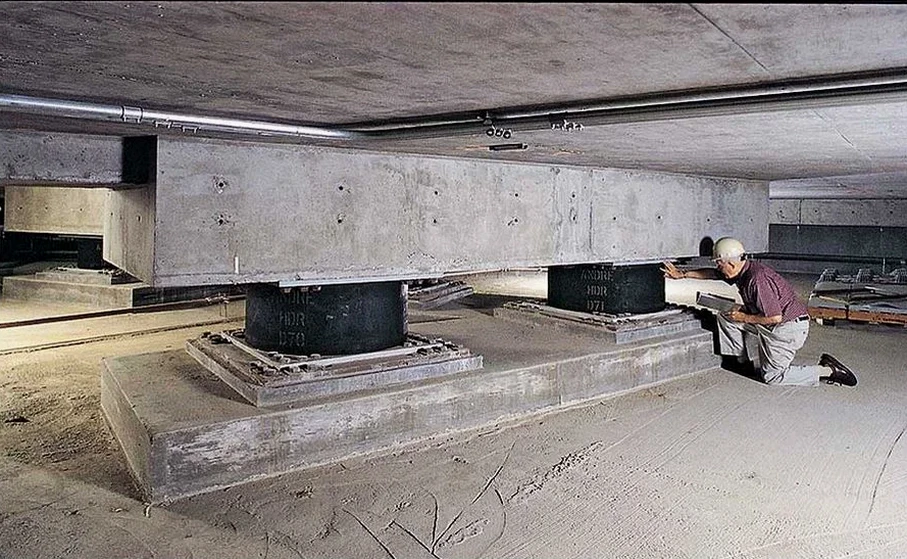
Technical reference image — Barnsley

Local ground factors

The typical mistake we see on Barnsley jobs is running a standard site investigation with SPTs at 1.5 m intervals, pulling generic Vs30 from the BGS database, and handing it to the isolator supplier. The problem is that the Coal Measures mudstone weathers unevenly: a competent band at 4 m can mask a softened zone at 6 m that will shear during a long-period event. If the isolator period lands on the amplified site period, you get resonance instead of isolation. We have seen borehole logs from the Dodworth area where Su drops from 120 kPa to 45 kPa across a single weathered horizon. Without lab dynamic testing on that softened material, the structural model is guessing. Getting the damping right matters too: overestimate it, and you under-design the isolator displacement capacity. The cost of fixing that after construction in a Barnsley brownfield site dwarfs the cost of the lab programme upfront.

Need a geotechnical assessment?

Reply within 24h.

Email: contact@geotechnical-engineering.biz

Technical data

ParameterTypical value
Small-strain shear modulus Gmax (MPa)Determined by bender element / resonant column per BS EN ISO 17892
Normalised shear modulus reduction curve G/GmaxStrain-controlled cyclic triaxial, range 1x10⁻⁴ to 1%
Damping ratio D (%)Hysteretic loop analysis per BS 1377, strain-dependent curve
Undrained shear strength ratio Su/σ'vFrom CIUC triaxial at in-situ stress level
Vs profile (m/s) to 30 m depthMASW or cross-hole, cross-checked with lab bender elements
Site class per BS EN 1998-1 Table 3.1Vs30 (B, C, D or E) with SPT blowcount corroboration
Design response spectrum parametersagR, S, TB, TC, TD per UK National Annex to BS EN 1998-1

Other technical services

01

Dynamic Soil Characterisation

Resonant column and cyclic triaxial testing on undisturbed Shelby tube samples taken from the isolator bearing stratum. We produce the full strain-dependent stiffness and damping curves (G/Gmax and D vs. log strain) that feed structural analysis software. Every test is run at in-situ effective stress with pore pressure measurement throughout.

02

Site Response Analysis Input

We compile the Vs profile from surface-wave testing, cross-check it against lab bender element data, and build the 1D soil column model. Outputs include the surface response spectrum, amplification factors, and the time-history acceleration at the isolator level. This replaces the default Eurocode spectrum with site-specific ground motion.

03

Isolator Design Parameter Report

A summary document that translates the lab and field data into the parameters a bearing manufacturer needs: effective period, effective damping, design displacement, and maximum considered earthquake displacement. We also flag any near-fault effects or basin-edge effects relevant to the Barnsley site location relative to the Pennine fault system.

Applicable standards

BS EN 1998-1:2004 + UK National Annex (Eurocode 8: Design of structures for earthquake resistance), BS EN 1997-1:2004 + UK National Annex (Eurocode 7: Geotechnical design), BS EN ISO 17892 series (Geotechnical investigation and testing – Laboratory testing of soil), BS 5930:2015 (Code of practice for ground investigations), BS 1377 (Standard Test Methods for the Determination of the Modulus and Damping Properties of Soils)

Quick answers

Why can't we just use the generic Eurocode spectrum for a base-isolated building in Barnsley?

The generic Type 1 or Type 2 spectrum in BS EN 1998-1 assumes a flat reference rock condition and does not account for the stiff-over-soft impedance contrast common in the Dearne Valley. Soft alluvial clays at 5–12 m depth can amplify long-period motion by a factor of 2 or more. If the isolator period coincides with the amplified site period, the structure sees higher spectral acceleration than the code spectrum predicts. Site-specific dynamic lab testing and response analysis are the only way to capture that amplification reliably.

What does the lab testing programme for base isolation cost in Barnsley?

A full dynamic characterisation programme — resonant column, cyclic triaxial with bender elements, and the parameter report — typically falls in the range of £2,910 to £6,780 depending on the number of strata tested, the depth of the bearing layer, and whether we need to run additional consolidation-stage tests for pore pressure response. We provide a fixed-price quote after reviewing the borehole logs and the structural engineer's isolator specification.

How long does the laboratory testing take from sample arrival to the isolator design report?

Undisturbed samples need to be trimmed and set up within 48 hours of arrival to prevent moisture loss. The resonant column stage takes 3–5 working days per specimen. Cyclic triaxial testing, which involves multiple strain stages with pore pressure equilibration between each, requires 7–10 working days per specimen. We can run specimens in parallel if multiple setups are available. A typical two-stratum programme delivers the final design parameter report within 4 calendar weeks of sample receipt.
Location and service area

We serve projects across Barnsley and surrounding areas.

View larger map