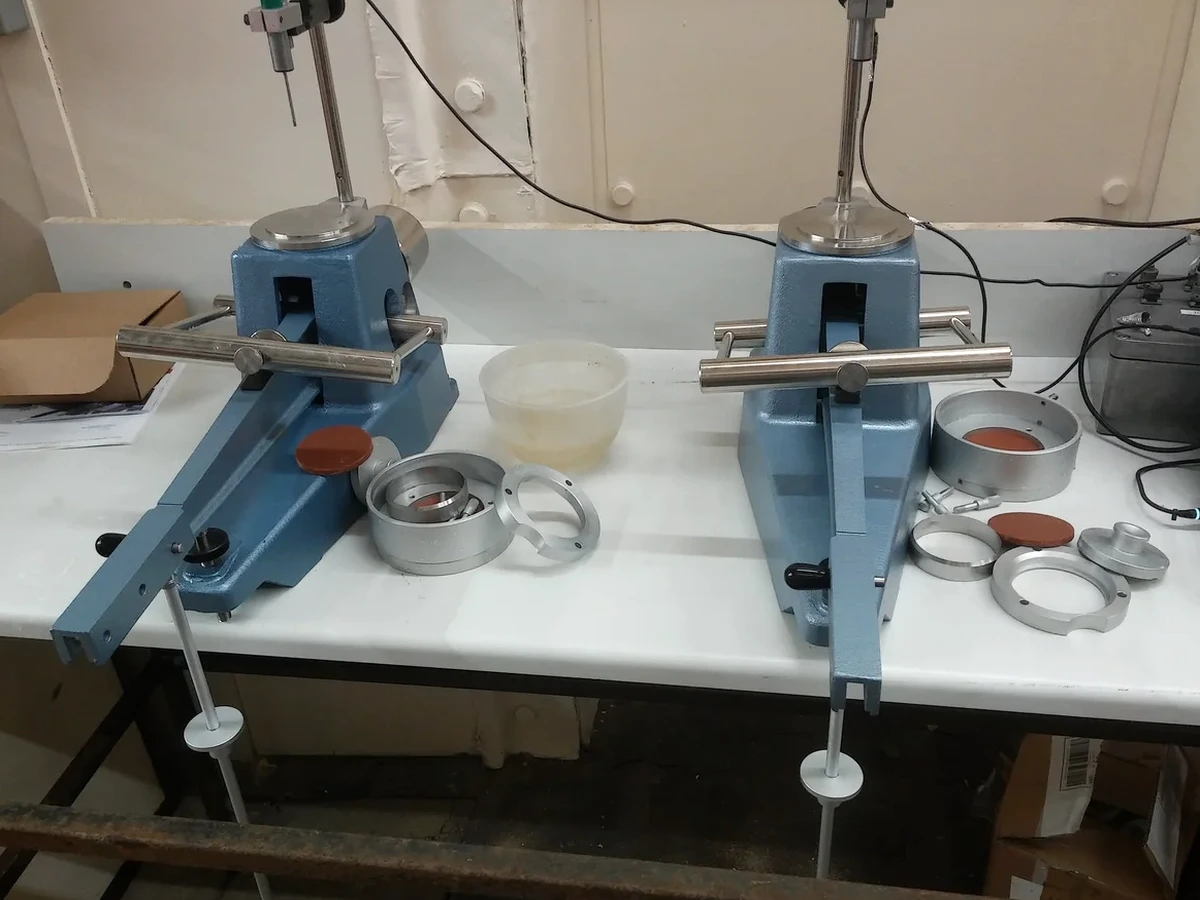
Barnsley's ground doesn't read textbooks. Decades of mining and the underlying Coal Measures geology have left a legacy of mixed fills, weathered mudstones and silty clays that behave unpredictably when wet. We see it on site every week: a material that stands firm in dry weather turns to slurry after a week of Yorkshire rain. That's where Atterberg limits testing stops being academic and becomes a practical necessity. The liquid limit and plastic limit define the moisture range where fine-grained soils transition from solid to plastic to liquid, and in Barnsley's reclaimed colliery land, missing that window means rework, delays or worse. Our laboratory runs these tests to BS 1377-2:1990, giving you the plasticity index and liquidity index values that feed directly into bearing capacity calculations, earthworks specifications and slope stability models. For sites near the Dearne Valley where alluvial silts complicate the profile, we often pair this with a grain size analysis to distinguish clay behaviour from silt behaviour before finalising the foundation design.
Plasticity index isn't just a classification number. It controls swell potential, consolidation rate and the moisture sensitivity of your subgrade, and in Barnsley's post-industrial ground, it changes by the metre.
Local ground factors
Barnsley's growth through the 19th and 20th centuries was fuelled by coal, glass and linen, and that industrial boom left a subsurface that still surprises developers. Colliery spoil, ash fill and reworked natural ground are common across the borough, from the town centre to the M1 corridor sites near Dodworth and Stairfoot. The geotechnical risk that Atterberg limits expose here is volumetric instability. A high-plasticity clay fill with PI above 30 percent will swell when it takes on water and shrink when it dries, cycling with every wet winter and dry summer. That movement cracks slabs, shears services and opens joints in retaining structures. Even a low-PI silt can fail if the liquidity index climbs above 0.8 under poor drainage, triggering bearing failure in shallow footings. Our reports flag these conditions early, referencing Eurocode 7 (BS EN 1997-2:2007) for ground investigation and giving the design team the classification and consistency data needed to decide between removal, stabilisation or deep foundations.
Quick answers
What do Atterberg limits actually tell me about my Barnsley site?
They define the moisture contents at which your fine-grained soil changes state. The liquid limit marks the boundary between plastic and liquid behaviour; the plastic limit marks the boundary between semi-solid and plastic. The plasticity index, their difference, correlates strongly with swell-shrink potential, undrained shear strength remoulded sensitivity, and compaction characteristics. On Barnsley's Coal Measures clays and glacial tills, these numbers directly inform foundation depth, subgrade treatment and drainage design.
How much does Atterberg limits testing cost?
A full Atterberg suite (liquid limit by cone penetrometer plus plastic limit) typically runs between £60 and £70 per sample in our Barnsley laboratory. If you need it as part of a combined classification package with particle size distribution, the rate adjusts accordingly. We provide a firm quote based on sample count and turnaround time before any work begins.
How long does the test take from sample to report?
Standard turnaround is three to five working days from sample receipt, assuming the material is already at its natural moisture content. If we need to air-dry a wet sample first, which is common with Barnsley's winter site conditions, add one day. We can expedite to 24 hours for urgent projects when the lab schedule permits.
Can you test samples that contain sand or gravel?
Atterberg limits apply strictly to the fine fraction passing the 425 µm sieve. If your sample contains significant sand or gravel, we wet-sieve it first and test only the fines. For a complete picture of such soils, we recommend pairing Atterberg with a full particle size distribution so you get both the plasticity of the fines and the grading of the coarse fraction in one report.