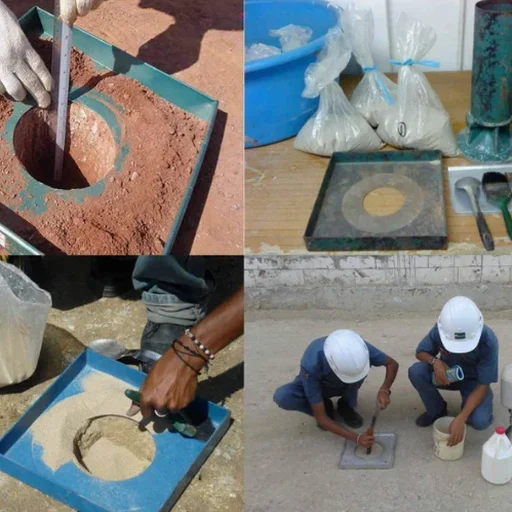
Barnsley’s transformation from a coal mining and glassmaking centre into a modern logistics and manufacturing hub has left a legacy of reclaimed land, backfilled shafts, and variable made ground across the borough. Every new warehouse slab off Junction 37 of the M1 or housing estate on former colliery land sits on engineered fill that must meet strict compaction criteria. The Proctor tests we run in the laboratory define the target dry density for each material type, and the field density test (sand cone method) verifies that the placed fill actually reaches it. Without this link between lab reference and field measurement, even well-graded crushed sandstone from local quarries can underperform under traffic loading or foundation stress. Our team works across Barnsley, from the town centre redevelopment zones to the greenfield edges near the Peak District fringe, delivering density results within hours of site testing so that compaction rolling can continue without delay.
A single failed density test on a 300 mm lift can stop compaction across an entire earthworks shift—we deliver results fast enough to keep the rollers moving.
Local ground factors
Barnsley sits on the Middle Coal Measures, a sequence of interbedded sandstone, siltstone, mudstone, and occasional thin coal seams. Much of the town’s developable land is underlain by made ground from mining and industrial activity, typically 1 to 4 metres thick, containing ash, colliery spoil, brick rubble, and uncompacted fill. Placing engineered fill over such a formation without density verification creates a real risk of differential settlement between cut and fill zones, particularly where soft spots or old backfilled shafts were not properly excavated and replaced. The sand cone method detects weak areas that proof rolling alone misses, because it quantifies the actual dry density rather than just observing surface deflection. On slopes greater than 1 in 10, under-compacted fill can also contribute to shallow rotational slips after heavy rain, a pattern documented in several South Yorkshire earthwork failures on former mining sites. A programme of field density testing, combined with in-situ permeability checks where drainage blankets are installed, gives the design engineer confidence that the compacted platform will perform as modelled.
Quick answers
How much does a sand cone field density test cost in Barnsley?
A single sand cone density test in Barnsley typically costs between £80 and £110, depending on the number of tests booked per day and the travel distance from our laboratory. Most earthworks projects require a minimum of 6–10 tests per day to cover the lift area, and we adjust the day rate accordingly. The price includes daily sand calibration, excavation and moisture content determination, and a signed test sheet with the relative compaction result.
How many density tests do I need per lift?
The standard frequency under the Specification for Highway Works (Series 600) is one test per 500 square metres per compacted lift, with a minimum of three tests per lift regardless of area. We recommend increasing the frequency to one test per 250 square metres in zones of variable fill, around drainage structures, and within 2 metres of retaining walls where compaction is harder to achieve.
Can the sand cone method be used on all Barnsley fill types?
The sand cone method works well on most compacted fills found on Barnsley sites, including crushed sandstone, shale, glacial till, and recycled aggregates, provided the maximum particle size does not exceed 37.5 mm. For fills containing cobbles or large fragments of demolition rubble, we recommend supplementing sand cone tests with larger-volume replacement methods or zone testing to avoid unrepresentative results.
What Proctor reference value should I use for site-won Coal Measures fill?
Site-won fill from the Middle Coal Measures in Barnsley—typically weathered mudstone and siltstone—usually achieves a maximum dry density between 1.85 and 2.05 Mg/m³ under standard Proctor compaction, with an optimum moisture content around 12–16%. However, these values shift with weathering grade and clay mineral content, so we always run a new Proctor curve on a bulk sample taken from the active borrow area rather than relying on historical data.