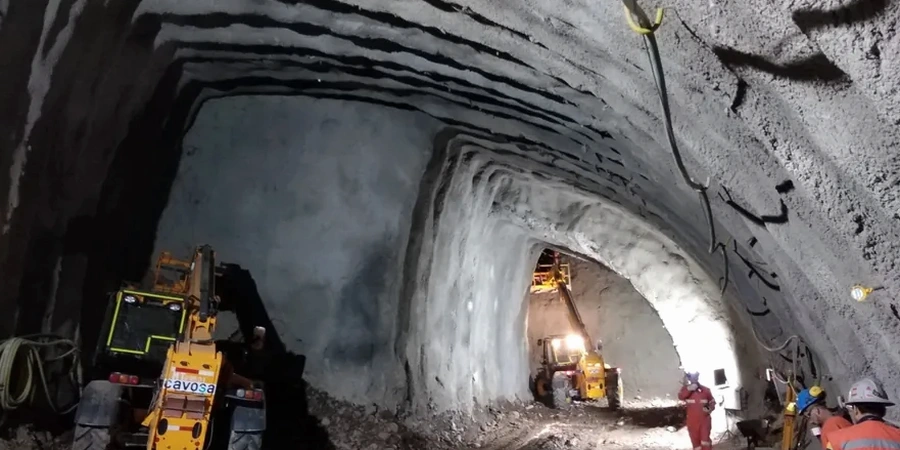
The single biggest mistake we see on tunnel projects around Barnsley is treating the ground as a uniform mass. A desk study says 'glacial till' and everyone assumes consistent behaviour, but the reality across the Dearne Valley is far more complicated. You've got lenses of laminated clay, pockets of running sand, and weathered mudstone horizons that degrade the moment they're exposed to air. When a TBM hits one of these transitions without proper advance characterisation, the downtime costs are brutal. Our approach starts with a targeted ground investigation that maps these boundaries before they become surprises, combining in-situ permeability testing with high-quality sampling so the design team actually knows what's ahead of the face. Barnsley's industrial legacy adds another layer: old mine workings, backfilled shafts, and undocumented culverts that standard borehole grids miss entirely. We pull all this together under a Eurocode 7 framework so the temporary support design isn't based on wishful thinking.
Understanding the transition between Barnsley's glacial cover and the Coal Measures beneath is what separates a tunnel drive that stays on programme from one that stops dead.
Local ground factors
Barnsley grew fast during the nineteenth-century coal boom, and the ground beneath the town still carries the scars. The Coal Authority's interactive map shows hundreds of recorded mine entries within a five-kilometre radius of the town centre, and those are just the documented ones. When you're driving a tunnel through soft ground here, the hazard isn't just the void itself: it's the disturbed annular zone around old shafts where the ground has been loosened by collapse and water ingress over decades. Add to this the alluvial deposits along the River Dearne corridor, which include compressible organic silts, and you've got a recipe for differential settlement that can damage surface structures half a kilometre from the tunnel alignment. Our risk assessments incorporate a detailed review of historical mining plans alongside modern CPT testing to catch zones of low cone resistance that signal backfilled workings. The Building Safety Act 2022 has sharpened everyone's liability, and the Health and Safety Executive expects a much higher standard of geotechnical justification for underground works than even five years ago.
Quick answers
What are the main geotechnical challenges when tunnelling through Barnsley's ground conditions?
The dominant challenge is the unpredictability of the ground. The superficial geology across Barnsley includes glacial till, alluvium, and head deposits that vary in thickness from two to over twenty metres within a single site. Beneath this, the Pennine Middle Coal Measures contain multiple worked seams, and the intervening mudstones are prone to rapid deterioration when wetted. Perched groundwater in sand lenses within the till is another recurring issue that complicates face stability. Our investigations are designed to map these variations with sufficient resolution that the contractor can plan interventions before encountering them.
How much does a geotechnical investigation for a soft-ground tunnel project in Barnsley typically cost?
For a tunnel project in the Barnsley area, the geotechnical investigation and laboratory testing programme generally falls between £3,150 and £13,230, depending on the length of the alignment, the number of boreholes required, and the complexity of the testing suite. A short drive with straightforward ground conditions sits at the lower end; a longer alignment crossing the Dearne Valley with mine workings investigations and advanced triaxial testing will be at the upper end. Every proposal we issue is priced against a detailed scope so you can see exactly what you're paying for.
How do you account for old mine workings when planning a tunnel in Barnsley?
We start with a thorough review of the Coal Authority's mining reports and historical abandonment plans, cross-referenced with modern topographic surveys. In the field, we use rotary open-hole drilling with flush return monitoring to detect voids or collapsed ground, and we log any evidence of coal, ash, or colliery spoil in the samples. Where a shaft is identified within the zone of influence of the tunnel, we model the disturbed ground around it and recommend either grouting or realignment. The goal is to ensure that no unanticipated void is encountered at the face.