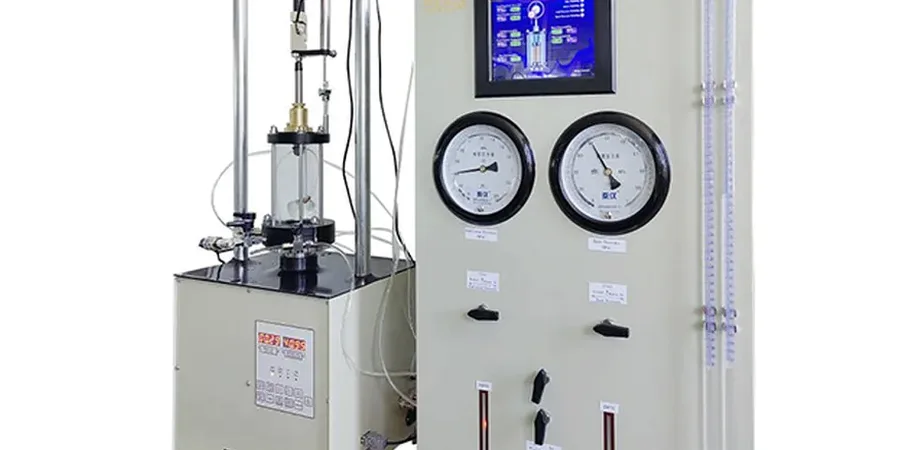
Barnsley’s built environment rests on a complex legacy of Carboniferous Coal Measures overlain by glacial till and alluvial deposits along the River Dearne, a stratigraphy that has influenced local construction since the first deep mines were sunk in the 19th century. The town’s redevelopment from pit yards to modern industrial estates and residential schemes places significant demand on foundation design, particularly where backfilled shafts and variable drift thicknesses create stiffness contrasts across relatively short distances. When standard penetration testing cannot fully resolve the effective stress behaviour of these materials, the triaxial test provides the constitutive parameters—effective cohesion and friction angle—required for rational geotechnical analysis. Our laboratory, operating under UKAS-accredited procedures to BS 1377-8:1990, performs consolidated undrained and drained triaxial compression on undisturbed samples recovered from boreholes advanced through the Middle Coal Measures sandstone and mudstone that underlie much of the Barnsley area, delivering the strength envelopes that structural engineers need to satisfy Eurocode 7 design requirements.
Triaxial testing converts the uncertainty of a complex glacial and mining-affected ground profile into a defined Mohr-Coulomb failure envelope that an engineer can defend to a building control check.
Quick answers
What is the typical turnaround time for a triaxial test programme on Barnsley samples?
A standard set of three CU triaxial tests on 100 mm diameter specimens typically requires 10 to 14 working days from sample receipt to the final interpretive report. The consolidation stage alone can take 24 to 48 hours depending on the permeability of the glacial till, and shearing at the prescribed strain rate adds a further 1 to 2 days per specimen. Drained tests on granular materials require significantly longer due to the slow strain rate needed to prevent pore pressure build-up; we advise allowing up to 3 weeks for a full CD suite. We provide preliminary results as they become available if the construction programme is time-sensitive.
What size and quality of sample is needed for a reliable triaxial test?
Undisturbed Class 1 samples to BS EN ISO 22475-1 are essential for obtaining meaningful effective stress parameters. We recommend 100 mm diameter thin-wall tube samples for the Coal Measures clay and glacial till, as smaller diameters are more susceptible to disturbance effects that reduce measured stiffness and peak strength. Samples must be sealed with wax immediately upon extrusion and transported in rigid core boxes to prevent vibration damage. If the material contains gravel-size particles exceeding 20% of the specimen diameter, the test may not be representative and a larger specimen or alternative in-situ testing approach should be considered.
How much does a triaxial test programme cost for a typical Barnsley project?
A standard programme of three CU triaxial tests with pore pressure measurement, including saturation, consolidation, shearing and a factual report with Mohr circles and stress paths, typically ranges from £1,290 to £1,900 depending on specimen size, consolidation stress levels and whether drained or undrained configurations are required. This is a laboratory-only cost and does not include the borehole drilling, sampling or transport to the lab, which we can arrange as part of a combined ground investigation package.
How do you interpret triaxial data for sites affected by shallow mine workings?
Samples taken from zones of collapsed or partially collapsed workings often exhibit a disturbed fabric that produces a lower secant stiffness and a reduced peak friction angle compared to intact material of the same lithology. Our interpretive approach involves plotting the stress path data (q-p' diagrams) to identify whether the soil is contractive or dilative at failure, which informs the selection of a critical state or peak strength envelope. Where pre-shearing is evident, we may recommend design values closer to the residual strength and advise on the applicability of ground improvement methods such as compaction grouting or stone columns to mitigate differential settlement before foundation construction.